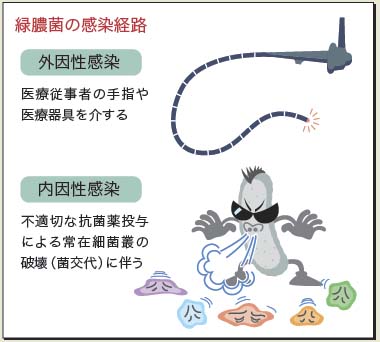
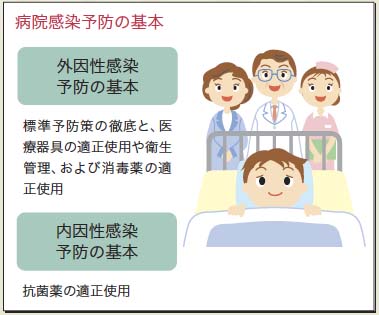
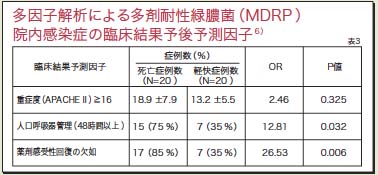
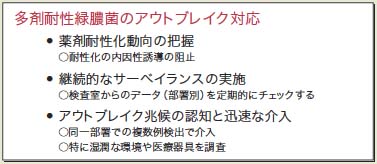
緑膿菌の外因性感染予防の基本は標準予防策の徹底と、医療器具の適正使用や衛生管理、および消毒薬の適正使用である。また内因性感染予防の基本は抗菌薬の適正使用、すなわち「緑膿菌感染症に限定した、薬剤耐性菌の選択・増殖を許さない短期強力型の抗菌薬治療」である。感染リスク因子および臨床結果予測因子を評価した上で医療機関全体での両者の遵守が望まれる。
参考文献
1) Kirschke DL, Jones TF, Craig AS, et al.: Pseudomonas aeruginosa and Serratia marcescens Contamination Associated with aManufacturing Defect in Bronchoscopes. N Engl J Med;348:214-220.2003
2) Srinivasan A, Wolfenden , Song X, et al.: An Outbreak of Pseudomonas aeruginosa Infections Associated with Flexible Bronchoscopes. N Engl J Med;348:221-227.2003
3) Harris A, Torres-Viera C, Venkeataraman L, et al.: Epidemiology and clinical outcome of patients with multiresistant Pseudomonas aeruginosa.Clin Infect Dis; 28: 1128-1133.1999
4) IDWR(感染症発生動向調査週報)ホームページ 感染症の話 2002年第17週号(http://idsc.nih.go.jp/idwr/index.htm)l
5) Defez C, Fabbro-Peray P, Bouziges N, et al.: Risk factors for multidrugresistant Pseudomonas aeruginosa nosocomial infection. J Hosp Infect; 57: 209-216.2004
6) Cao B, Wang H, Sun H, et al.: Risk factors and clinical outcomes of nosocomial multi-drug resistant Pseudomonas aeruginosa infections. J Hosp Infect; 57: 112-118.2004
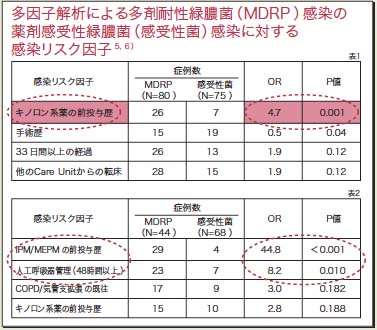
OR(odds ratio: オッズ比)
ある条件(因子)に当てはまる群が、その条件に当てはまらない群に比べて、ある結果(疾患など)を来たす可能性が何倍高いかを示す。つまり、オッズ比が高いほど、その条件と結果の因果関係が強いといえる。